


For most of human history, food came from plants and animals. You gathered it from a bush, hunted it, caught it in a river, or eventually grew and raised it on a farm.
Even in 1940, nearly one in four Americans lived on a farm, eating mostly what they could grow, raise, catch, or hunt. Were they healthier? Not in every way. Families with too little, or too little variety, suffered deficiency diseases.
But when people had enough to eat, they ate whole food, and type 2 diabetes and obesity, two of the strongest drivers of Alzheimer’s and other chronic diseases today, were rare.
Nutrition is one of the most powerful factors in health, and in brain health especially.
Fast forward to today.
You can buy a steak that came out of a 3D-printer!
When I first read that 3D-printed steak was being sold in American grocery stores, I didn’t believe it. I assumed it was one of those stories that circulates online and falls apart when you look under the hood. So I fact-checked it.
It’s real! Last month, an Israeli food-tech company called Steakholder Foods started selling 3D-printed “plant-based” meat in Northeastern U.S. stores under the brand name Perfecta.
Don’t let “plant-based” fool you: the plants in this case are soy flour and refined oils, held together with binders and starches, with little of the nutrition you’d get from actual plants.
The line includes a marbled steak, a filet mignon, chicken breast, salmon patties, and white fish patties. Nowhere on the package does it say the food came out of a printer.
Under U.S. labeling law, it doesn’t have to. Labels must list ingredients and allergens, but there’s no requirement to say how the food was made.
I had a hard time believing that was legal. Then I remembered that fake food has been legal for decades. Our grocery stores are full of products designed by food chemists to look, taste, and feel like something they aren’t. My great-grandmother wouldn’t even recognize them as food.
Perfecta is just one more ultra-processed product in a long line of them.
What makes it especially insidious is what it’s designed to replace. Beef, chicken, and fish provide essential nutrients the brain and body depend on, and a printed imitation looks like the real thing, even chews like the real thing, without supplying them.
Using supplements to make up the difference defeats their purpose, which is to be supplemental when needed. Replacing real food with supplements is not a good option for your health.
Most shoppers still trust that what’s sold as food is food. They’re busy, they’re feeding families, and they aren’t turning over every package. Even those who read the ingredient list aren’t likely to connect “rapeseed oil, methylcellulose, modified maize starch” to what happens in their brain down the road.
I don’t believe anyone would knowingly choose meat that came out of a 3D printer. The problem is, how would you know? And even if labeling is eventually required, the marketing pitch will be that it’s healthier than real meat, and vegans and vegetarians will be especially targeted.
It isn’t healthier for anyone: omnivore, herbivore, or carnivore.
No matter how advanced the technology becomes, or how similar they can make something taste, it can’t replace real food for the human body.
Here’s why as it relates to meat.
Three kinds of “meat” at the grocery store
When I talk about eating meat, and the many viewpoints on it, people picture the meat case at their grocery store. That’s where it gets complicated, because most of what’s there comes from animals raised far from the way they should naturally live.
Industrial agriculture took the first step decades ago. Cattle were moved off grass and into feedlots to be fattened on corn and soy. Chickens were moved into crowded barns with no sunlight. Salmon were moved into ocean pens and fed processed pellets. The animals got bigger and cheaper, and the meat lost much of what made it valuable to us.
Perfecta “meat” takes the next step and removes the animal entirely. That might sound appealing to a vegan or vegetarian, but it’s still an ultra-processed food, and it isn’t good for anyone.
So shoppers are choosing among three kinds of meat:
Printed imitations
Meat from industrially raised animals (most common today)
And meat from animals raised the way they naturally live - not as easy to find nowadays, but it’s out there when you know what you’re looking for.
I don’t eat the first two, ever. Here’s why each one matters for your brain.
What real meat and fish give your brain
Beef, chicken, and fish from well-raised animals provide a combination of nutrients the brain depends on. Many of them come only from animal foods, or are far more absorbable from them.
All nine essential amino acids. Your body can’t make these, so you have to eat them. Beef, chicken, and fish contain all nine in the proportions the human body uses.
From beef: vitamin B12, which plants don’t make and which the brain and nerves can’t function without. Heme iron, the form your body absorbs best, carries oxygen to a brain that uses about 20% of your body’s supply. Zinc is essential for communication between brain cells. Beef also provides creatine, which brain cells use for energy, and carnosine, an antioxidant concentrated in muscle and brain tissue.
From chicken: B6 and niacin, both needed to make neurotransmitters, plus selenium and choline. Choline is what your body uses to make acetylcholine, the neurotransmitter most depleted in Alzheimer’s.
From fish: DHA, the main structural fat in brain cell membranes. Low DHA levels are consistently linked to faster cognitive decline. Fish also provides EPA, an omega-3 that calms inflammation, along with iodine, selenium, and vitamin D. Fish and shellfish are also among the richest sources of taurine, which helps protect brain cells from overstimulation and oxidative damage. Taurine levels decline as we age.
Why Perfecta works against your brain
Perfecta is a premix of ingredients that is pushed through nozzles in thin layers, building up something that looks like beef, fish, or chicken.
Here’s the ingredient list for the marbled steak: water, soy flour, rapeseed oil, coconut oil, methylcellulose, natural flavoring, salt, beet root powder, modified maize starch, food coloring, caramel, xanthan gum, locust bean gum, and sunflower lecithin.
That’s fourteen ingredients.
A real steak is beef, a single whole food with B12, heme iron, zinc, creatine, and all nine essential amino acids naturally present.
Pefecta is missing what the brain counts on from meat and fish. There’s no B12, which the brain and nerves can’t function without, no DHA in the printed salmon, and no heme iron, creatine, or carnosine.
It has much less protein. The 9-ounce marbled steak has 26 grams of soy flour protein, while a real 9-ounce steak has more than 50, with all nine essential amino acids naturally present. The salmon patty, just under 2 ounces, has 4 grams. The same amount of real salmon has about 10.
Its fats promote inflammation. Refined canola oil is processed with high heat and chemical solvents that damage its fats. It adds to the omega-6 overload in the American diet, with no omega-3s to balance it, and chronic inflammation is one of the main drivers of Alzheimer’s.
Its binders and starches may disrupt your gut. Research suggests some of the texturizers and emulsifiers in processed foods can thin the gut’s protective lining and promote inflammation. Whatever affects the gut affects the brain.
It’s ultra-processed, and that pattern is the real risk. One analysis of the Perfecta steak classifies it as ultra-processed (NOVA 4), the most processed category. The research linking ultra-processed food to brain decline is consistent:
In UK Biobank data, every 10% increase in ultra-processed food intake was associated with a 25% higher risk of dementia.
A Brazilian study following over 10,000 adults found that people getting more than about 20% of their calories from ultra-processed foods had 28% faster cognitive decline.
In 2024, a large U.S. study linked each 10% increase in ultra-processed food to a 16% higher risk of cognitive impairment.
The same eating pattern is linked to type 2 diabetes and insulin resistance, heart disease, stroke, obesity, depression, colorectal cancer, gut dysbiosis, and higher all-cause mortality.
These are Alzheimer’s risk factors themselves. Insulin resistance is so tightly linked to the disease that some researchers call Alzheimer’s “type 3 diabetes.”
Why industrial meat also falls short
For decades, red meat has been blamed for heart disease, cancer, and more. But the large studies behind that reputation relied on food questionnaires that often lumped hot dogs, bacon, and deli meat together with unprocessed beef.
Here’s one that separated it, Micha et al., Circulation, 2010. A meta-analysis of 20 studies covering over a million people. Processed meat was associated with a 42% higher risk of heart disease and 19% higher risk of type 2 diabetes. Unprocessed red meat showed no significant association with either.
Feedlot beef
Most beef in this country spends its last four to six months in a feedlot, also called a CAFO (concentrated animal feeding operation), confined and fattened on corn and soy.
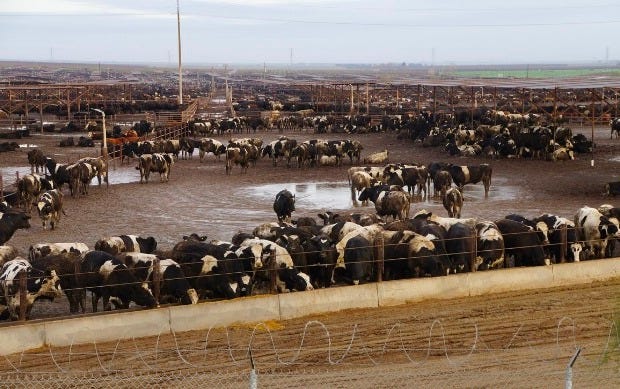
The grain diet damages cattle’s digestive tracts and livers, so antibiotics go into their feed every day. The meat ends up with fewer omega-3s and antioxidants and more omega-6.
Routine antibiotic use in food animals is also a major driver of antibiotic-resistant bacteria, which affect all of us.
Confined chickens
Most chicken is raised in windowless barns holding thousands of birds, with no sunlight and no access to the outdoors. Chickens naturally forage for insects, worms, seeds, and greens.
Confined chickens eat only corn and soy, and they’re bred to reach market weight in six or seven weeks, fast enough to damage their own muscle tissue.
Farmed salmon
Farmed salmon are crowded into ocean pens and fed pellets made increasingly from soy and vegetable oils. Their omega-3 levels dropped by about half in less than a decade, and their pink color comes from a pigment added to the feed.
Taste
Chicken, beef and salmon taste different when raised in these conditions. It’s not subtle, and it’s not good.
You don’t know it because you have probably been eating it most or all of your life.
I remember grilling hamburgers when my mother-in-law was over many years ago. She couldn’t believe how good they tasted. She actually said “this tastes like the hamburger I had when I was a kid”. She was born in 1937.
What well-raised meat gives you
When cattle are raised regeneratively and finished on grass, moved frequently across pasture in a way that rebuilds the soil, the differences are measurable:
The omega-6 to omega-3 ratio drops dramatically. In one major review, it was about 1.5 to 1 in grass-finished beef versus roughly 7.5 to 1 in grain-finished.
CLA, vitamin E, and beta-carotene are higher. The yellow tint you sometimes see on grass-finished fat comes from the beta-carotene.
Phytochemicals from the pasture plants show up in the meat. Grain-finished beef has far fewer of them.
Antibiotics aren’t routinely needed, because the animals are eating what they’re meant to eat.
Saturated fat isn’t one thing.
It’s a family of fatty acids that behave differently in the body. Grass-finished beef tends to contain more stearic acid, a saturated fat with a neutral effect on LDL cholesterol, and less myristic and palmitic acid, the saturated fats most associated with raising LDL.
The total amount of saturated fat is about the same; what changes is which saturated fats you’re getting. Grass-finished beef also has less fat overall, and that fat comes with more omega-3s, CLA, and antioxidants. (Daley et al., Nutrition Journal, 2010)
Context matters too. Saturated fat eaten alongside sugar and refined carbohydrates is a different metabolic situation from saturated fat in a whole-food diet that keeps insulin in check.
If you eat plant-based
Many people buying products like Perfecta may be making a thoughtful choice for ethical, personal health, environmental, or religious reasons, and that choice deserves respect.
A whole-food plant-based diet built on lentils, beans, tempeh, tofu, nuts, seeds, and vegetables is real food, and it can be done well for the brain.
What concerns me is the growing category of processed imitations. They’re marketed as the healthy choice. Nutritionally, they belong on the same shelf as other ultra-processed foods.
A word about saturated fat and ApoE4
To be clear, I’m not telling you to eat more meat, or any meat at all. Just that if you do eat it, where it comes from matters a great deal for your brain.
I also know the question you may be asking if you carry the ApoE4 gene: doesn’t the saturated fat in meat raise cholesterol, and doesn’t that increase my risk for heart issues or dementia?
Dr. Bredesen’s answer for ApoE4 carriers is to limit saturated fat. E4 carriers tend to see a bigger rise in LDL cholesterol from saturated fat than people without the gene. He recommends getting most of your fat from olive oil, avocado, nuts, seeds, and wild fatty fish, and keeping red meat a smaller part of the plate, from grass-fed, well-raised animals, and that’s advice people using the ReCODE protocol should follow.
That said, E4 carriers and people in general can vary widely in how they respond, so he recommends that we rely on lab testing to guide each person rather than a single rule.
Of course, a basic cholesterol panel does not provide enough information.
Cholesterol deserves its own conversation, and I’ll be covering it in an upcoming post.
Here’s how to use what you now know:
How to take the confusion out of the labels
What I buy and where
How I get the benefits of liver into my diet without tasting it (not a supplement)
The 6 labs that tell you what your diet is doing